
 0
0
 0
0
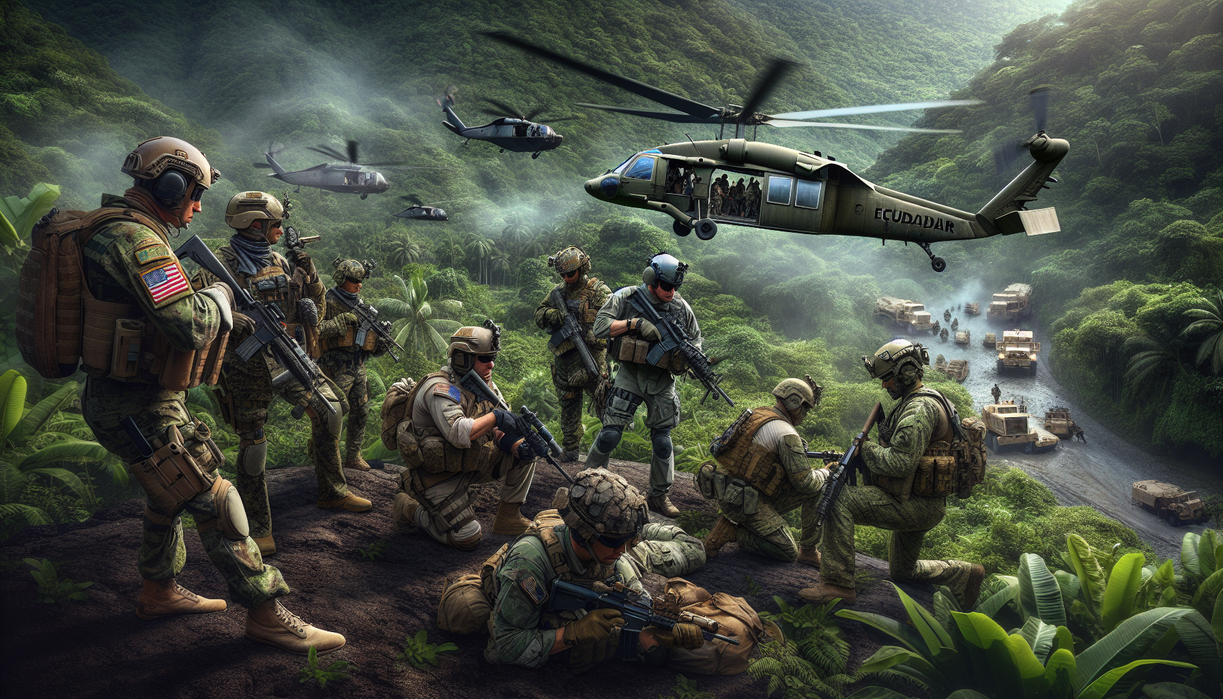
www.thediegoscopy.com – Ecuador has stepped into a new and controversial phase in its struggle against narcotrafficking, as fresh footage reveals coordinated anti-drug strikes carried out with United States forces. These joint operations highlight how Ecuador, once considered relatively calm in comparison to its neighbors, has turned into a key battleground in the regional drug trade. The images of lethal raids, aerial surveillance, and armed patrols tell a stark story about the country’s shifting security landscape and the global stakes surrounding it.
At the center of this transformation lies a difficult question: how far should Ecuador go in pursuing military solutions to its drug crisis, especially with direct U.S. involvement on its territory? Supporters claim these interventions are essential to dismantle powerful criminal networks. Critics warn that an overreliance on force risks eroding sovereignty, fueling human rights abuses, and repeating past mistakes seen elsewhere in Latin America. Understanding what happens next in Ecuador is crucial for anyone concerned with security, democracy, and regional stability.
Ecuador’s New Reality on the Frontline
Ecuador sits between two of the world’s largest cocaine producers, Colombia and Peru, which makes it a crucial corridor for traffickers. For years, cartels treated Ecuador as a discreet export platform, exploiting its ports, dollarized economy, and weaker enforcement. That quiet role has now exploded into visible conflict, with prison massacres, targeted assassinations, and open clashes in port cities like Guayaquil. The joint anti-drug strikes with U.S. forces are the latest escalation, signaling that authorities view this crisis as a quasi-war requiring heavy firepower and foreign assistance.
The newly released footage reportedly shows coordinated air and ground operations, with Ecuadorian units working alongside U.S. forces under the umbrella of U.S. Southern Command. This collaboration includes intelligence sharing, aerial surveillance, and direct lethal engagements against suspected trafficking infrastructure. For many in Ecuador, the images are both reassuring and unsettling. On one hand, they project resolve against brutal gangs. On the other, they confirm that foreign militaries now play a visible role in the country’s internal security.
My perspective is that Ecuador has reached a point where ignoring international help is no longer realistic, yet relying heavily on foreign military power carries hidden costs. Partnerships with Washington can bring advanced technology, training, and strategic support. Still, they often arrive with political strings, complex legal arrangements, and a tendency to prioritize short-term results over long-term social rebuilding. Ecuador’s leaders must navigate this alliance carefully to avoid turning a necessary security boost into a lasting dependency.
The Roots of Ecuador’s Drug Surge
To understand why Ecuador is now hosting joint military strikes, you need to look at the structural forces behind its drug surge. The country’s strategic geography is only part of the equation. Decades of underinvestment in coastal communities, weak institutions, and chronic corruption created fertile ground for cartels. Ports like Guayaquil became gateways for massive cocaine shipments, while poorly monitored rural regions provided storage, logistics, and corridors toward the Pacific. As Colombian and Peruvian groups faced pressure at home, they increasingly outsourced operations to local Ecuadorian gangs hungry for power and profit.
Another key factor is the fragmentation of criminal organizations. Instead of a single dominant cartel, Ecuador now hosts a patchwork of gangs competing for territory, extortion routes, and control of prisons. This competition produces spectacular violence that shocks the public and erodes confidence in the state. Authorities often respond with heavy-handed crackdowns, which in turn can strengthen the more ruthless groups. In this chaotic environment, U.S. support appears attractive: sophisticated intelligence tools can map networks, track shipments, and locate high-value targets with greater precision.
However, I worry that focusing almost exclusively on Ecuador’s geography and gangs oversimplifies the crisis. Drug markets adapt faster than law enforcement, migrating routes and methods whenever pressure intensifies. If Ecuador becomes too costly, traffickers will explore alternative corridors or invest in more sophisticated concealment. Sustainable progress therefore requires more than selective strikes; it demands resilient institutions, credible justice systems, opportunities for at-risk youth, and a long-term vision that sees communities as partners rather than collateral terrain.
U.S.–Ecuador Cooperation: Help or Hindrance?
The partnership between U.S. Southern Command and Ecuador’s security forces raises essential questions about sovereignty, accountability, and strategy. On a practical level, joint operations can indeed disrupt shipments, unsettle cartel leadership, and signal that the state refuses to surrender territory. U.S. technology, such as surveillance aircraft, drones, and advanced analytics, gives Ecuador a powerful edge it would struggle to obtain alone. Still, history across Latin America shows the risks of allowing foreign militaries a deep footprint in domestic conflicts. Past anti-drug campaigns often delivered fleeting tactical victories while leaving behind militarized policing, damaged civil liberties, and communities distrustful of both local authorities and foreign partners. My view is that Ecuador should treat this cooperation as a narrow, time-bound tool within a broader national strategy, not as the core solution. Success will depend on transparent agreements, parliamentary oversight, human rights safeguards, and a parallel investment in social programs, justice reform, and anti-corruption drives. Without this balance, Ecuador might win individual battles against traffickers yet lose the larger war for democratic strength and citizen trust.
Life on the Ground: Beyond the Battlefield Footage
While the joint anti-drug strikes in Ecuador generate dramatic footage, the most important story unfolds far from cameras. For residents of coastal barrios, border towns, and overcrowded prisons, the conflict is not an abstract geopolitics issue. It shapes whether they can open a small business without paying extortion, send children to school safely, or trust the police who patrol their streets. Many communities in Ecuador are caught between violent gangs on one side and an increasingly militarized response on the other, with little space for nuanced solutions. These people rarely make headlines, yet they bear the greatest risks.
Civil society groups across Ecuador warn that intensifying military operations can increase short-term violence, especially if gangs retaliate. They also point out that abusive raids or mistaken killings erode public confidence, pushing residents to cooperate less with investigators. When U.S. forces participate, the legitimacy challenge deepens, because any misstep becomes a symbol of foreign interference. That does not mean all cooperation is harmful, but it does mean that transparency and local engagement are vital. Communities must see that security measures protect them, not just defend ports or satisfy international partners.
I believe the most responsible path for Ecuador is to pair targeted security actions with visible investment in social resilience. Programs that support education, job creation, mental health, and youth engagement may sound softer than military strikes, yet they often provide the most durable protection against gang recruitment. If a teenager in Guayaquil or Esmeraldas sees no realistic legal future, offers from criminal networks feel rational. No drone or commando unit can fully counter that logic. The real test for Ecuador is whether the current militarized response opens a window for deeper reforms instead of substituting for them.
Lessons from Latin America’s Long Drug War
Ecuador is not the first country in the region to invite U.S. military support against drug trafficking. From Plan Colombia to security cooperation in Central America and Mexico, Latin America has lived through multiple waves of intense counternarcotics campaigns. These experiences provide both inspiration and caution. On the positive side, Colombia’s state regained control over large territories, reduced some guerrilla influence, and improved operational capabilities. However, the long-term picture is far more mixed, with new criminal groups rising as old ones fell, and cocaine production shifting rather than disappearing.
Mexico’s militarized drug war offers additional warnings. Despite years of collaboration with U.S. agencies, cartel violence remains severe, institutional corruption persists, and communities distrust both security forces and politicians. Targeted killings of bosses frequently trigger internal power struggles instead of ending trafficking. These patterns show that security operations alone rarely alter the structural drivers of the drug economy. Ecuador risks walking down a similar path if it equates more raids and arrests with strategic victory. Violence might spike, morph, or move, but the underlying market could remain intact.
From my standpoint, the main lesson for Ecuador is to avoid treating the current joint strikes as a ready-made blueprint. Instead, the country should study what worked elsewhere in combination with deeper reforms. Strengthening judicial independence, tackling money laundering in the financial system, and protecting investigative journalism can undercut criminal empires more effectively than relying solely on foreign hardware. If Ecuador’s elites treat narcotrafficking as a temporary security nuisance rather than a systemic threat to governance, history suggests the problem will keep returning in different forms.
Ecuador’s Choice: Security or Transformation?
The images of U.S. and Ecuadorian forces carrying out lethal anti-drug operations present a powerful narrative: a state under siege, fighting back with determination and modern weaponry. Yet behind that narrative lies a more complex dilemma. Ecuador must choose whether this moment becomes a launching point for deep institutional transformation or just another chapter in an endless cycle of crackdowns. Lethal strikes may win tactical engagements, but they cannot rebuild trust, reform prisons, or offer youths alternatives to the criminal underworld. A truly secure Ecuador will emerge not only from the skies where drones patrol or from the seas where ships intercept cocaine, but also from classrooms, honest courts, and neighborhoods where residents feel heard. The country stands at a crossroads; its decisions now will shape whether the war on drugs further erodes democratic life or instead ignites a broader movement toward inclusive, resilient security.


